Jump to content
Main menu
Main menu
move to sidebar
hide
Navigation
Main page
Recent changes
Random page
Special pages
WikiChilopoda
Search
Search
Appearance
Create account
Log in
Personal tools
Create account
Log in
Pages for logged out editors
learn more
Contributions
Talk
Editing
Scolopendra polymorpha
Page
Discussion
English
Read
Edit
View history
Tools
Tools
move to sidebar
hide
Actions
Read
Edit
View history
General
What links here
Related changes
Page information
Appearance
move to sidebar
hide
Warning:
You are not logged in. Your IP address will be publicly visible if you make any edits. If you
log in
or
create an account
, your edits will be attributed to your username, along with other benefits.
Anti-spam check. Do
not
fill this in!
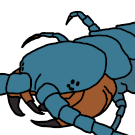
{{Chilopoda species infobox | name = Scolopendra polymorpha | image = Scolopendra_polymorpha.jpg | caption = ''S. polymorpha'' | subclass = Notostigmophora | order = Scolopendromorpha | family = Scolopendridae | genus = Scolopendra | species = S. polymorpha | binomial = Scolopendra polymorpha | authority = Wood, 1861 }} '''Scolopendra polymorpha''', also known as the '''tiger centipede''', is a species of centipede found in North America. ==Distribution== Found in the Southwestern US and northern Mexico. ==Identification== 7th-12th antennomeres sparsely hirsute; distomedial tubercles of ultimate prefemora with 4-12 (usually 4) distal spurs apiece; eastern border of Central Plains (eastern Nebraska-Texas) to south eastern Montana, the Rocky Mountains of Wyoming-New Mexico, northwestern New Mexico to southwestern Idaho and southeastern Oregon to the Pacific Coast north of San Francisco Bay to the Mexican border (Shelly 2002) ==Biology== A predator, ''S. polymorpha'' will ambush prey at higher prey densities while resorting to active search in lower densities. Specimens in California can be found after rain, usually on moist soil under rocks. (Shelley 2002) ==Toxicology== Reported as harmless allergic reactions notwithstanding, with a possible sharp temporary pain. (Shelly 2002) ==Description== S. polymorpha, nobis. S. olivaceo-brunnea, capite dilute castaneo; antennis 30 articulatis, pedibusque luteolis; dente mandibulari tuberculo basali magno; dentibus labialibus 3, maxillis, intimis dubius utrinque coadunatis, externis sejunctis; segmentis tibi margine posteriore nigro-viride, marginis lateralibus plurimque liberis; pedibus postremis robustis, articulo basali inus 7–10 spinis, subtus 8–12 spinis arrato, processu angulari arti bifido aut trifido aut quadrifido; appendicibus analibus lateralibus, singula 4–5 spinis apicalibus. Long. unc. 3. Praebasilar fold apparent, but connate with the rather large basilar segment. First segment of body very small, suture between scutum and episcutum barely traceable, that between sternum and episternum much more distinct. Basal joint of last pair of legs, above flattened and apparently grooved, below very convex; the internal surface having near to it a proximal end a group of from five to seven spines, and several scattered ones on its distal portion; lower surface with from eight to ten spines disposed 1 in rows. This may be considered the typical arrangement, but we have very numerous departures from it; in some individuals the spines are irregularly scattered over the whole interior and inferior surfaces. The color also varies greatly, shading off from that given above, to a testaceous-duscent, the posterior green bands entirely vanishing. Even the characters drawn from the labial teeth are not constant in this perplexing species, these organs in some individuals being small and coadunate. One of our testaceous specimens has attained to the length of three and one-half inches. Hab. Fort Riley, Kansas. Presented by Dr. Hammond. (Wood 1861) ==References== Shelley, R. M. (2002). A synopsis of the North American centipedes of the order Scolopendromorpha (Chilopoda). Virginia Museum of Natural History. Wood, H. C., Jr. (1861). Descriptions of new species of Scolopendra in the collection of the Academy. Proceedings of the Academy of Natural Sciences of Philadelphia, 13, 10–15. https://www.biodiversitylibrary.org/item/17713
Summary:
Please note that all contributions to WikiChilopoda may be edited, altered, or removed by other contributors. If you do not want your writing to be edited mercilessly, then do not submit it here.
You are also promising us that you wrote this yourself, or copied it from a public domain or similar free resource (see
Chilopoda Wiki:Copyrights
for details).
Do not submit copyrighted work without permission!
Cancel
Editing help
(opens in new window)
Template used on this page:
Template:Chilopoda species infobox
(
edit
)
Search
Search
Editing
Scolopendra polymorpha
Add topic